

Can I Use Digital Site Plans for Commercial Permits?
Many business owners and commercial property managers ask the same question when planning a construction or renovation project. Can I use digital site plans for commercial permits? This question usually comes up when someone wants faster approvals, lower costs, and fewer delays. Traditional methods often involve physical surveys, printed drawings, and long waiting times. Digital site plans offer a modern alternative.
Today, most city and county permit offices accept electronic submissions. This has changed how commercial site plans are created and reviewed. Digital site plans are now commonly used for retail spaces, office buildings, warehouses, restaurants, and many other commercial projects.
In this guide, we explain everything in simple terms. You will learn what digital site plans are, how they are used for commercial permits, when they are accepted, and when additional documents may be required. This article is written for business owners, contractors, and first time commercial applicants.
What Is a Digital Site Plan
A digital site plan is an electronically prepared drawing that shows the layout of a commercial property. It is created using digital tools and reliable data sources rather than hand drawn sketches or paper based methods.
Digital site plans display property boundaries, existing buildings, proposed construction, parking areas, access points, and required distances from property lines. These plans are delivered in electronic formats that permit offices can easily review.
The goal of a digital site plan is the same as a traditional one. It helps permit reviewers understand how a commercial project fits within zoning and land use rules. The difference is how the plan is created and delivered.
Why Commercial Permits Require Site Plans
Commercial permits involve more review than residential projects. Cities need to make sure commercial developments meet zoning, safety, and land use requirements.
A site plan helps permit reviewers check building placement, parking layout, fire access, setbacks, and overall site organization. Without a clear site plan, it is difficult for a planning department to approve a commercial permit.
Because of this, site plans are a standard requirement for commercial permits. Whether the plan is digital or traditional, clarity and accuracy are what matter most to reviewers.
Are Digital Site Plans Accepted by Cities and Counties
In most cases, yes. Many city and county permit offices now accept digital site plans for commercial permits. Electronic submission has become common across the United States.
Permit offices focus on whether the site plan meets their requirements, not how it was created. As long as the plan clearly shows required details and follows local guidelines, digital plans are often accepted.
Some jurisdictions even prefer digital plans because they are easier to review, store, and share between departments. This shift has made digital site plans a practical option for many commercial projects.
How Digital Site Plans Are Created for Commercial Projects
Digital site plans are created using modern drafting tools combined with reliable public data. Professionals use parcel records, zoning maps, satellite imagery, and planning overlays to understand the property layout.
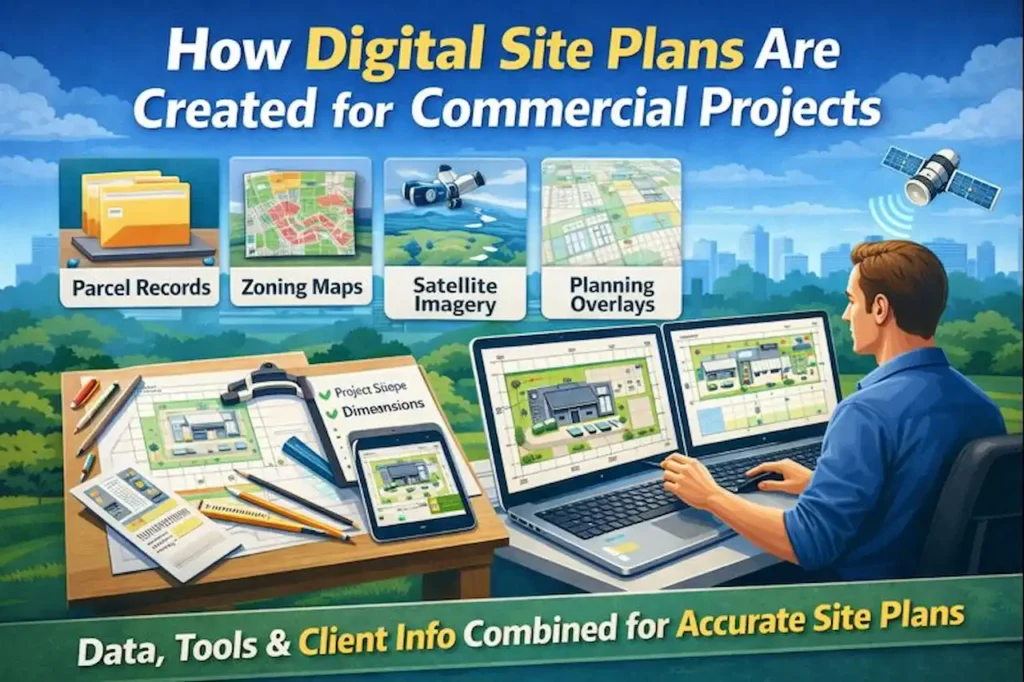
These data sources allow accurate representation of buildings, parking areas, and property boundaries. Measurements and distances are carefully added to match zoning and permit requirements.
Client provided information such as project scope, proposed changes, and building dimensions is also used. All of this information is combined into a clear and readable site plan prepared for permit review.
What Information a Commercial Digital Site Plan Must Show
Commercial site plans must include specific details to be approved. These details help permit reviewers verify compliance with local rules.
A digital site plan usually shows property lines, existing structures, proposed construction, parking spaces, driveways, sidewalks, and required setbacks. Some projects also require landscaping areas, loading zones, or utility locations.
The exact requirements depend on the city and project type. A well prepared digital site plan includes all necessary elements so the permit office does not request revisions.
Digital Site Plans Versus Traditional Paper Plans
Traditional paper plans were once the standard for permit submissions. They required printing, scanning, and physical delivery. This process often caused delays and errors.
Digital site plans are created and submitted electronically. This makes them easier to update, revise, and share with permit reviewers. Digital plans also reduce the risk of lost documents or unclear scans.
For commercial permits, digital site plans offer speed and flexibility without sacrificing accuracy. This is why many professionals now prefer digital methods.
Do Commercial Digital Site Plans Replace Surveys
Digital site plans do not replace surveys in every situation. Surveys are legal documents prepared by licensed professionals to verify exact property boundaries.
For many commercial permits, a survey is not required if the site plan clearly shows layout and compliance. However, some projects still require surveys, such as property subdivisions, boundary changes, or large scale developments.
The permit office will usually state when a survey is required. If the application only asks for a site plan, a digital site plan may be sufficient.
Types of Commercial Projects That Use Digital Site Plans
Many commercial projects successfully use digital site plans for permits. These include retail tenant improvements, office remodels, parking reconfigurations, signage permits, and small building additions.
Restaurants, warehouses, medical offices, and mixed use properties often submit digital site plans during the permit process. As long as the plan meets local requirements, digital formats are widely accepted.
Each project should be reviewed individually, but digital site plans work well for most standard commercial permits.
Common Reasons Digital Site Plans Get Rejected
Digital site plans are accepted, but quality still matters. Rejections usually happen because required information is missing or unclear.
Common issues include missing setbacks, incorrect parking counts, unclear property boundaries, or outdated zoning data. These problems are not related to the digital format but to preparation quality.
A professionally prepared digital site plan reduces these risks and improves approval chances.
How Digital Site Plans Speed Up Commercial Permit Approval
Digital site plans help speed up the permit process in several ways. They are easy to submit, review, and revise.
Permit reviewers can zoom in, measure distances, and share comments electronically. This reduces back and forth communication and shortens review cycles.
For business owners, faster permit approval means projects can start sooner. This makes digital site plans a valuable tool for commercial development.
How to Decide If a Digital Site Plan Is Right for Your Project
The best way to decide is to review your permit application requirements. If the application asks for a site plan and does not specify a stamped survey, a digital site plan is often acceptable.
Contacting the local planning department can also provide clarity. Many permit offices openly support digital submissions.
Choosing a professional service that understands commercial permit requirements helps ensure your digital site plan meets expectations.
Conclusion
So, can you use digital site plans for commercial permits? In most cases, yes. Many city and county permit offices across the United States now accept digital site plans for commercial projects. As long as the site plan clearly shows property layout, setbacks, parking, and proposed construction, the digital format itself is not a problem.
Digital site plans help business owners and contractors save time and reduce costs. They eliminate the need for printed drawings and allow faster review by planning departments. However, acceptance always depends on meeting local requirements. Some projects may still require additional documents, such as surveys, especially for large developments or boundary changes.
The key takeaway is simple. Digital site plans are widely accepted for commercial permits when they are prepared professionally and follow zoning and permit guidelines. Understanding your local requirements and using the right approach can make the permit process smoother and faster.
Why Choose Us
We specialize in preparing digital site plans specifically for commercial permit approval. Our team understands how city and county permit offices review commercial applications and what they expect to see on a site plan.
We use reliable GIS data, zoning information, and satellite imagery to create clear and accurate digital site plans. Each plan is carefully prepared to reflect local planning requirements and commercial zoning rules.
Our process is fully online, which means faster turnaround times and fewer delays. If revisions are requested by the permit office, we assist with updates so your application can move forward smoothly.
Our focus is simple. Provide permit ready digital site plans that help business owners, contractors, and developers get approvals without unnecessary complications.
Frequently Asked Questions
Are digital site plans accepted for commercial permits everywhere
Many cities and counties accept digital site plans, but requirements vary by jurisdiction. It is always best to check the local permit application guidelines.
Do digital site plans replace traditional paper plans
In most cases, yes. Many permit offices prefer electronic submissions because they are easier to review and manage.
Do I still need a survey for a commercial site plan
Not always. Surveys are required only when the permit office specifically asks for one, such as for boundary changes or subdivisions.
What file format do permit offices accept
Most permit offices accept PDF files. Some may also accept CAD files depending on local requirements.
Can digital site plans be used for large commercial projects
Digital site plans are commonly used for many commercial projects. Large or complex developments may have additional requirements.
Why do permit offices reject digital site plans
Rejections usually happen due to missing information, incorrect measurements, or zoning issues, not because the plan is digital.
How long does it take to prepare a digital site plan
Digital site plans are usually prepared faster than traditional plans, depending on project complexity.
Can revisions be made to a digital site plan
Yes. One of the benefits of digital plans is that updates and revisions can be made quickly.
Are digital site plans more affordable
Digital site plans are often more cost effective than traditional survey based methods.
How do I know if my city accepts digital site plans
You can check your permit application checklist or contact the local planning department directly.