

Can I Get a Site Plan Without Hiring a Surveyor?
Many homeowners, contractors, and small business owners face the same question when applying for a building permit. Can I get a site plan without hiring a surveyor? This question usually comes up when someone wants to save time, reduce costs, or avoid delays in the permit process. Hiring a surveyor can be expensive, slow, and sometimes unnecessary depending on the type of project and the city requirements.
A site plan is one of the most common documents requested by city and county permit offices across the United States. It shows how a property is laid out and how a proposed project fits within zoning and setback rules. Many people assume that a land survey is always required to create a site plan. In reality, that is not always true.
In this guide, we explain everything in simple terms. You will learn what a site plan is, how it is different from a survey, when a surveyor is required, when it is not required, and how site plans can be prepared without visiting the property. This article is written for beginners and first time permit applicants, so no prior technical knowledge is needed.
What Is a Site Plan and Why Cities Ask for It
A site plan is a scaled drawing that shows a property from a top view. Cities and counties use site plans to understand how a project fits on the land. It helps permit reviewers check zoning rules, setbacks, lot coverage, and spacing between structures.
A typical site plan shows property boundaries, existing buildings, proposed construction, driveways, fences, utilities, and distances between structures and property lines. The purpose of a site plan is not to prove legal ownership or boundary accuracy. Its main purpose is to show layout and compliance with local regulations.
Permit offices rely on site plans to make sure a project does not violate zoning rules or create safety issues. This is why site plans are required for many permits, even for small projects like sheds, decks, fences, and home additions.
What Is a Land Survey and How It Is Different from a Site Plan
A land survey is a legal document prepared by a licensed surveyor. It establishes exact property boundaries using physical measurements taken on site. Surveys are often used for property purchases, legal disputes, boundary clarification, and subdivision approvals.
A site plan is not a legal boundary document. It is a planning and permitting document. While a survey focuses on precise boundary accuracy, a site plan focuses on layout and compliance. This difference is very important because it explains why a survey is not always required.
Many people confuse site plans and surveys because they both show property lines. However, the level of precision and legal responsibility is very different. A surveyor certifies legal accuracy. A site plan drafter prepares a permit ready layout based on available data.
Do You Always Need a Surveyor for a Site Plan
The short answer is no. You do not always need to hire a surveyor to get a site plan approved.
Most cities do not require a new land survey for standard residential and light commercial permits. Instead, they require a clear and accurate site plan that shows property layout, setbacks, and proposed work. As long as the site plan meets zoning and planning requirements, it is often accepted.
Surveyors are usually required only when legal boundary verification is needed. This includes property disputes, subdivisions, boundary adjustments, or projects that significantly change land configuration. For common permit applications, a professionally prepared site plan without a survey is often enough
When Cities Accept Site Plans Without a Survey
Many city and county permit offices across the United States accept site plans prepared without a survey when certain conditions are met. These conditions focus on clarity, accuracy, and completeness rather than legal boundary certification.
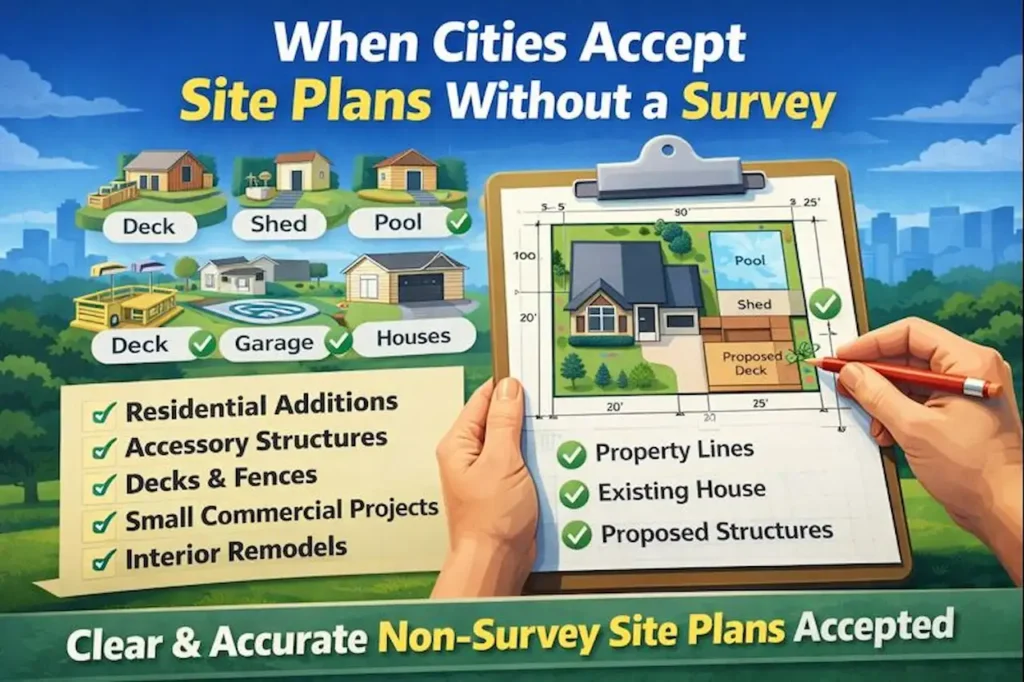
Cities typically accept non survey site plans for residential additions, accessory structures, decks, fences, sheds, pools, garages, and interior remodels that affect building footprint. Small commercial projects and tenant improvements also often qualify.
Permit reviewers mainly want to see distances from property lines, existing structures, and proposed construction. As long as these distances are shown clearly and reasonably, a survey is usually not required.
How Site Plans Are Created Without Visiting the Property
Modern site plans can be created without physically visiting the property. This is possible because of reliable digital data sources that are commonly used in planning and permitting.
Site plan professionals use GIS data, satellite imagery, county parcel maps, and zoning overlays to understand property boundaries and layout. These sources provide enough information to create accurate permit ready site plans for most projects.
By combining public records with client provided information such as sketches or measurements, a complete site plan can be prepared remotely. This approach saves time and eliminates the need for on site surveys in many cases.
What Data Is Used Instead of a Physical Survey
When a survey is not required, site plan drafters rely on multiple trusted data sources. These include county assessor maps, GIS parcel data, satellite images, and zoning maps. These sources are commonly used by local governments themselves.
Satellite imagery helps identify existing structures, driveways, and lot shape. GIS data provides parcel boundaries and dimensions. Zoning maps show setbacks and land use rules. Together, these sources allow accurate representation of the property layout.
While these data sources are not used for legal boundary certification, they are widely accepted for planning and permit purposes.
Types of Projects That Usually Do Not Require a Survey
Many permit applications can move forward without a surveyor. Home improvement projects are the most common examples. These include decks, sheds, fences, pergolas, patios, and small additions.
Interior remodels that do not change the building footprint usually do not require surveys. Even some exterior projects only need a site plan showing existing conditions and proposed changes.
Light commercial projects such as signage, small expansions, or parking layout adjustments also often qualify. Each city is different, but surveys are not automatically required for most routine permits.
When Hiring a Surveyor Is Actually Required
There are situations where a surveyor is required and cannot be avoided. These usually involve legal land changes or high risk projects.
Subdivision applications almost always require surveys. Boundary disputes, lot line adjustments, and property splits also require licensed surveyors. New construction on undeveloped land may require surveys depending on local rules.
If a permit office specifically asks for a stamped survey, then a surveyor must be hired. In these cases, a site plan alone is not sufficient.
Risks of Submitting a Poor Quality Site Plan
While surveys are not always required, quality still matters. A poorly prepared site plan can delay or reject a permit application. Missing setbacks, unclear dimensions, or incorrect zoning information can cause problems.
Permit reviewers expect site plans to be clear, readable, and complete. Even without a survey, distances must be shown accurately and consistently. Professional drafting is important to avoid rejections and resubmissions.
Using unreliable sketches or guessing measurements increases the risk of permit delays. This is why professionally prepared site plans are strongly recommended.
How a Professional Site Plan Improves Approval Chances
A professional site plan is designed specifically for permit approval. It follows city formatting expectations and includes all required elements.
Professionally prepared plans show property lines, setbacks, existing structures, proposed work, and measurements clearly. They are created using reliable data and verified against local requirements.
Permit offices recognize professionally prepared plans and often process them faster. This saves time and reduces frustration during the permit review process.
Cost Comparison Between Surveys and Site Plans
One of the biggest reasons people ask about site plans without surveyors is cost. Surveys can be expensive and time consuming. They often cost significantly more than a permit ready site plan.
Site plans prepared without surveys are more affordable and faster. They meet permit needs without the added expense of legal boundary certification. For many homeowners and small projects, this makes a major difference.
Choosing the right document for the right purpose helps control project costs while still meeting city requirements.
How to Know If Your City Requires a Survey
The best way to confirm requirements is to check your local permit application checklist or contact the planning department. Many cities clearly state whether a survey is required.
In most cases, permit offices ask for a site plan, not a survey. If a survey is required, it is usually mentioned explicitly. If the application only mentions a site plan, a professionally prepared plan without a survey is often acceptable.
Understanding this distinction helps applicants avoid unnecessary expenses.
Why Online Site Plans Are Growing in Popularity
Online site plans are becoming more popular because they are fast, affordable, and convenient. They allow property owners to apply for permits without scheduling site visits or hiring surveyors.
Digital site plans can be prepared quickly and delivered electronically. This matches how most permit offices now accept applications.
As cities modernize their processes, online site plans are becoming a practical and widely accepted solution.
Common Myths About Site Plans and Surveyors
Many people believe that a site plan must always come from a surveyor. This is a common misconception. In reality, most site plans are prepared by drafting professionals using public data.
Another myth is that cities automatically reject non survey plans. This is also not true. Cities focus on compliance, not who prepared the plan.
Understanding these myths helps property owners make informed decisions.
How to Get a Site Plan Without Hiring a Surveyor
The easiest way is to work with a professional site plan service that specializes in permit ready drawings. These services understand local requirements and know how to prepare plans that cities accept.
You typically provide your property address, project details, and any available documents. The site plan is then prepared using reliable data and delivered digitally.
This process saves time, reduces cost, and helps avoid permit delays.
Conclusion
So, can you get a site plan without hiring a surveyor? In many cases, yes. For most residential and light commercial permit applications, cities and counties do not require a new land survey. What they need is a clear, accurate, and permit ready site plan that shows property layout, setbacks, and proposed construction.
Understanding the difference between a site plan and a land survey helps you avoid unnecessary costs and delays. Surveys are important for legal boundary verification, subdivisions, and special cases. However, for common projects like decks, sheds, fences, home additions, and many remodels, a professionally prepared site plan without a survey is often accepted.
The key is quality and accuracy. A well prepared site plan that follows local zoning and permit requirements improves approval chances and keeps your project moving forward. By choosing the right approach, you save time, reduce expenses, and avoid frustration during the permit process.
Why Choose Us
We specialize in preparing permit ready site plans that are accepted by city and county permit offices across the United States. Our process is designed to help homeowners, contractors, and business owners move forward without unnecessary complexity.
We use reliable GIS data, satellite imagery, and jurisdiction specific zoning information to prepare accurate site plans without requiring a property visit or a land survey in most cases. Each plan is carefully reviewed to match local permit requirements.
Our team understands how permit offices review site plans. This allows us to create drawings that are clear, complete, and easy for reviewers to approve. We focus on accuracy, clarity, and fast turnaround, so your permit application does not get delayed.
If your city requires revisions, we work with you to make the necessary updates until your site plan meets submission requirements. Our goal is simple. Help you get approved without stress or unnecessary costs.
Frequently Asked Questions
Do all permits require a land survey
No. Most permits require a site plan, not a land survey. Surveys are usually required only for legal boundary verification, subdivisions, or when the permit office specifically asks for one.
Will my city accept a site plan without a survey
Many cities and counties accept professionally prepared site plans without surveys for common residential and light commercial projects. Acceptance depends on local requirements and project type.
How accurate is a site plan without a survey
A site plan without a survey is accurate enough for planning and permit review. It is prepared using GIS data, satellite imagery, and public records commonly used by permit offices.
Can I get a site plan without visiting the property
Yes. Site plans can be prepared remotely using digital data sources and property records. This is common and widely accepted for permit applications.
What types of projects usually do not require a survey
Decks, sheds, fences, pools, garages, home additions, and many remodels usually do not require surveys. Each city may have different rules, so checking local requirements is recommended.
What happens if my permit office asks for changes
If revisions are required, a professional site plan can be updated to meet the reviewer’s comments. This is a normal part of the permits a survey
No. A survey is a legal boundary document prepared by a licensed surveyor. A site plan is a planning and permitting drawing focused on layout and zoning compliance.
How long does it take to get a site plan
Turnaround time is usually much faster than hiring a surveyor. Many site plans are completed within a short time frame depending on project complexity.
Can I use an old site plan for a new permit
Sometimes. If the property layout has not changed, an existing site plan may be usable. However, many permit offices prefer updated drawings.
How do I know if my project needs a survey
Check your permit application checklist or contact your local planning department. If a survey is required, it will usually be stated clearly.