

Can I Get a Site Plan Without Visiting the Property?
Many homeowners, contractors, and business owners ask the same question when applying for a permit: can I get a site plan without visiting the property? This question usually comes up when someone wants to save time, reduce costs, or avoid delays caused by scheduling an on site visit. In today’s digital world, many services have moved online, and site plan creation is one of them.
City permit offices still require accurate and clear site plans, but the way those plans are created has changed. With access to public records, satellite imagery, zoning data, and digital mapping tools, it is now possible in many cases to create a permit ready site plan without physically going to the property. However, this approach does not apply to every project or every city.
This guide explains everything you need to know. You will learn how online site plans work, when a site visit is not required, when it may still be necessary, how cities review these plans, and what to expect during the permit process. The goal is to give you a clear and simple answer so you can decide the best path for your project.
What Is a Site Plan and Why Cities Require It
A site plan is a detailed drawing that shows how a property is laid out. It includes property boundaries, existing structures, proposed construction, distances from property lines, driveways, utilities, easements, and other important details. Cities use site plans to make sure a project follows zoning rules, building codes, and safety standards.
When you apply for a building permit, the city needs to see how your project fits on the land. They want to confirm setbacks are respected, structures are not built in restricted areas, and utilities are properly placed. A site plan gives reviewers a clear visual reference so they can approve or request changes before construction begins.
Because this document plays such an important role in permit approval, accuracy matters more than how it is created. Cities focus on whether the information is correct and complete, not whether someone physically visited the site.
The Traditional Way of Creating a Site Plan
In the past, site plans were commonly created after an on site visit. A surveyor or designer would go to the property, take measurements, and record details manually. This method is still used today, especially for complex projects or undeveloped land.
Traditional site visits can take time to schedule and often increase the overall cost of a project. Weather, access issues, and availability can also cause delays. For small residential projects, this process may feel unnecessary, especially when much of the required information already exists in public records.
While on site visits are still valuable in certain situations, they are no longer the only option for creating a permit ready site plan.
How Online Site Plans Are Created Without a Site Visit
Online site plans are created using a combination of verified data sources and digital tools. Instead of visiting the property, professionals gather information remotely and use it to produce an accurate drawing.
These plans are typically created using satellite imagery, county parcel data, recorded surveys when available, zoning maps, and city requirements. Measurements are taken digitally, and property boundaries are verified using official records. The final plan is then drawn to scale and formatted according to permit submission standards.
Because the data comes from trusted sources, the resulting site plan can meet city requirements without requiring physical access to the property. This approach works well for many residential and light commercial projects.
Data Sources Used for Remote Site Plan Creation
Remote site plans rely on multiple layers of data to ensure accuracy. One source alone is not enough. Professionals cross check information to reduce errors and meet permit standards.
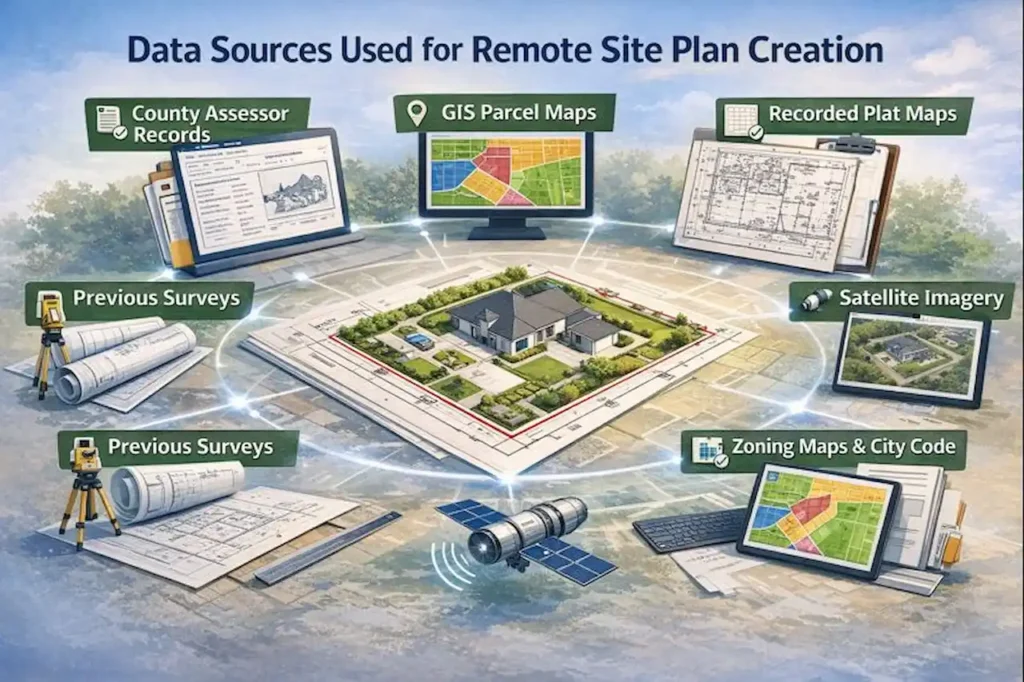
Common data sources include county assessor records, GIS parcel maps, recorded plat maps, and previous surveys when available. Satellite imagery provides a visual reference for structures, driveways, and land features. Zoning maps and city code documents help ensure compliance with local rules.
By combining these sources, it is possible to produce a site plan that clearly represents the property and proposed work without an on site visit.
When You Can Get a Site Plan Without Visiting the Property
In many cases, a site visit is not required. This is especially true for standard residential projects where the property is already developed and well documented.
Examples include fence permits, deck additions, sheds, patios, pools, driveways, and small home additions. These projects usually involve clear boundaries and existing structures that are visible in public records and satellite images.
Many cities accept digitally created site plans for these types of permits as long as the plan is accurate, scaled correctly, and includes all required details. In these situations, getting a site plan online can be faster and more cost effective.
Situations Where a Site Visit May Still Be Required
Although online site plans work for many projects, there are cases where a site visit may still be necessary. This usually happens when accurate data is not available or when the project involves complex conditions.
Examples include undeveloped land, properties with unclear boundaries, major grading changes, new subdivisions, or areas with strict environmental regulations. Some cities also require certified surveys for specific types of construction.
If a permit office specifically requests a stamped survey or field verified measurements, an online site plan may not be enough. In these cases, a professional will inform you early so you can take the correct next step.
Do Cities Accept Site Plans Without a Site Visit
Yes, many cities do accept site plans created without a site visit. The key factor is not how the plan was created but whether it meets the city’s requirements.
Permit reviewers focus on clarity, accuracy, scale, and compliance with zoning rules. If the site plan clearly shows property lines, setbacks, structures, and proposed work, it can be approved even if no one physically visited the property.
Acceptance varies by city and project type. That is why experienced site plan services review local requirements before preparing the drawing. This ensures the final plan aligns with what the city expects.
Accuracy and Reliability of Online Site Plans
A common concern is whether online site plans are accurate enough for permits. When prepared correctly, they can be highly reliable.
Accuracy depends on the quality of data used and the experience of the professional creating the plan. Cross checking multiple data sources helps reduce errors. Clear labeling and proper scaling also play a major role in city approval.
It is important to understand that no method is perfect. Even traditional site visits rely on interpretation and measurements. The goal is to create a plan that meets permit requirements and accurately represents the property for review purposes.
Common Misconceptions About Site Plans Without Site Visits
Many people assume that cities will automatically reject any plan created without a physical visit. This is not true. Cities care about compliance, not the method used.
Another misconception is that online site plans are low quality or incomplete. In reality, professionally prepared digital site plans often include more detail than hand drawn sketches or homeowner created diagrams.
Some also believe that a survey is always required. While surveys are important in certain cases, many permits do not require a new survey if reliable data already exists.
How the Permit Review Process Works With Online Site Plans
Once you submit your site plan with your permit application, the city reviews it just like any other plan. Reviewers check setbacks, zoning compliance, utility placement, and overall layout.
If something is missing or unclear, the city may issue comments requesting revisions. This does not mean the plan is invalid. It simply means adjustments are needed. Online site plans are easy to revise since they are already in digital format.
Once revisions are completed and resubmitted, the city continues the review process until approval is granted.
Advantages of Getting a Site Plan Without Visiting the Property
One major advantage is speed. Without the need to schedule a site visit, the process can move forward quickly. This is especially helpful when permit deadlines are tight.
Cost is another benefit. Remote site plan services are often more budget friendly than traditional surveys. This makes them accessible for homeowners and small projects.
Convenience also plays a role. Everything can be handled online, from data collection to final delivery. This reduces stress and keeps projects moving forward.
Limitations You Should Be Aware Of
While online site plans offer many benefits, it is important to understand their limitations. They rely on existing data, so if records are outdated or incomplete, adjustments may be needed.
They are also not a replacement for legal boundary surveys when those are required by the city. In such cases, a licensed surveyor may still be necessary.
Understanding these limitations helps set realistic expectations and prevents surprises during the permit process.
How to Know If Your Project Qualifies for a Remote Site Plan
The best way to know is to review your city’s permit requirements or consult with a professional site plan service. They can quickly determine whether your project can move forward without a site visit.
Factors include project size, location, zoning rules, and city specific guidelines. With the right review process, you can avoid unnecessary steps and choose the most efficient solution.
Conclusion
Getting a site plan without visiting the property is not only possible but also widely accepted for many permit applications today. With access to verified public records, satellite imagery, zoning maps, and digital drafting tools, site plans can be created accurately and efficiently without stepping foot on the property. This approach works especially well for residential projects and small commercial developments where property data is already available.
The key factor is not whether a site visit occurred, but whether the site plan meets city requirements. Permit offices care about accuracy, clarity, and compliance. When these elements are handled correctly, online site plans can move through the approval process smoothly and without delays.
Before starting your project, it is important to understand your city’s permit requirements and confirm whether a remote site plan is acceptable. When used in the right situation, this method can save time, reduce costs, and simplify the entire permit process.
Why Choose Us
We focus exclusively on creating permit ready site plans that meet city and county requirements across the United States. Our process is designed to eliminate unnecessary steps while maintaining accuracy and compliance.
We carefully review zoning rules, setback requirements, and permit guidelines before drafting any site plan. By using trusted data sources and proven methods, we ensure that each plan is clear, scaled correctly, and ready for submission.
Our team understands how permit reviewers think. That experience allows us to prepare site plans that reduce the chances of rejection and minimize revision requests. We also offer fast turnaround times and responsive support, making the process simple even for first time applicants.
Most importantly, we are transparent. If a site visit or survey is required for your specific project, we let you know upfront so you can make the right decision without wasting time or money.
Frequently Asked Questions
Can I really get a site plan without visiting my property
Yes, in many cases you can. If your property is already developed and reliable public data is available, a site plan can often be created without a physical site visit.
Do all cities accept site plans created online
Many cities do accept them, but acceptance depends on the project type and local permit rules. It is always important to match the site plan to the city’s requirements.
Is a land survey required for every site plan
No. Some permits require a survey, but many do not. If existing records provide enough information, a new survey may not be necessary.
How accurate are site plans created without a site visit
When prepared using verified data and professional drafting methods, these site plans are accurate enough for many permit applications.
What happens if the city asks for changes
Revisions can be made quickly since the plan is already digital. This helps keep the permit process moving without major delays.
How long does it take to receive a site plan
Turnaround time is often faster than traditional methods and can range from a few days to a week depending on project complexity.